



Editor's Note: This story originally appeared on LawnStarter.
Not knowing how to pick up leaves fast can make fall leaf cleanup take forever. The good news is that there’s more than one way to tackle leaf removal.
From raking and using leaf blowers to vacuuming, shredding, and mulching with a mower, here are the best ways to clean up leaves in your yard.
1. Raking Leaves: The Traditional Approach

- Project difficulty: Easy
- Estimated time to complete: A few hours to several days, depending on yard size and leaf volume
- Project cost: Low (leaf rakes cost around $10 to $30)
- Best for: Homeowners looking for low-cost cleanup for small to medium yards with light to moderate leaf fall, and who don’t mind a little workout.
Although it’s pretty old-school, raking leaves is cost-effective, which is why many homeowners still use it today.
Ryan Bearss, research assistant at Michigan State University, prefers using the leaves as lawn food. But if you choose to rake leaves, he advises raking and removing them as they fall. “No sense in putting off what can be done now.”
- Use a wide plastic rake for dry leaves and a metal rake with spring tines for damp or matted leaves.
- Work in sections to avoid getting overwhelmed.
- If it’s windy, rake in the same direction as the wind and into small piles of leaves. Bag as you go to keep them from being blown over.
- Remember to wear gloves to prevent blisters and take breaks to avoid back strain.
Pros:
- Inexpensive
- Great workout
- Quiet and peaceful
- Eco-friendly (No fuel or power needed)
Cons:
- Can be time-consuming
- Not ideal for large yards
- Labor-intensive, especially if done alone
2. Using Leaf Blowers (Fast and Efficient)
- Project difficulty: Easy
- Estimated time to complete: 30 minutes to 1.5 hours
- Project cost: Moderate — leaf blowers cost around $90 to $390 (plus fuel costs for gas-powered leaf blowers)
- Best For: Homeowners dealing with high leaf volume in medium to large yards, and who prefer minimal physical effort.
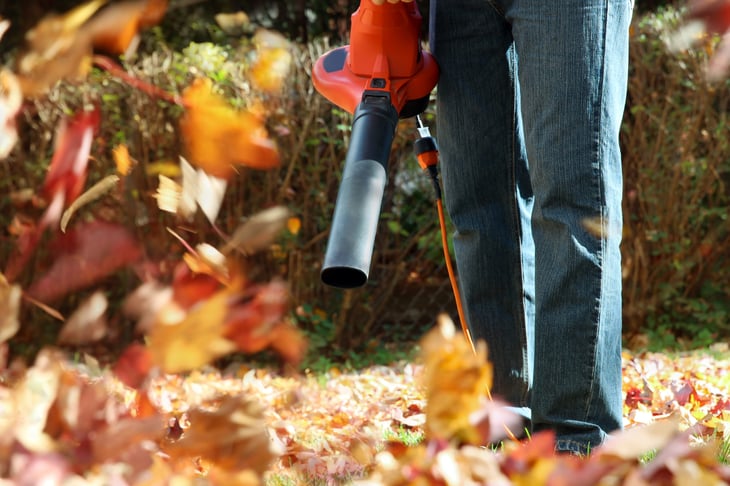
To make leaf removal fun, you can use a leaf blower instead of a rake. Whether you use electric or gas, handheld or backpack, this leaf removal tool is a major time-saver. It’s your best friend during the fall season when there are too many leaves in your yard.
- Use a low power setting around mulch beds or delicate landscaping to keep from blowing everything around.
- Work in lanes or rows, blowing leaves into piles at the edge of your yard or onto a tarp.
- Before using the leaf blower, manually clear out leaves from corners, flower beds, and under bushes first.
- Remember to wear eye and ear protection, especially when using gas-powered models.
Pros:
- Saves time for large properties
- Requires little physical effort
- Works well on dry or wet leaves
Cons:
- Gas-powered models are noisy and may disturb neighbors
- Gas models can be heavy or polluting
- If misused, leaf blowers can end up scattering leaves instead
3. Mulching With a Mower: 2-in-1 Solution

- Project difficulty: Easy
- Estimated time to complete: 30 minutes to 1.5 hours
- Project cost: Moderate — mulching lawn mowers cost around $200 to $400+ (plus fuel costs for gas-powered mowers)
- Best for: Homeowners who have medium to large yards with moderate leaf cover and are looking for low-effort lawn care without bagging or hauling.
If you don’t know what to do with fallen leaves and don’t want to use a rake or leaf blower, you can mulch the leaves instead.
For many homeowners, including Bearss, mulching is the go-to solution for cleaning up leaves.
“Plenty of research has demonstrated the benefits of leaving mulched leaves on lawns,” he says.
- Use a mulching mower or install a mulching blade on your regular mower.
- For best results, mow when the leaves are dry, as wet leaves tend to clump and may clog the mower.
- If the leaf layer covers more than 50% of your lawn, spread the leaves out first. Then, do a first pass to reduce the volume, and mow again to mulch the leaves into smaller pieces.
- Remember not to mulch leaves of diseased trees.
Pros:
- Saves both time and effort compared to raking
- Feeds your lawn naturally
- Eco-friendly and sustainable
- No need to bag or haul leaves
Cons:
- Only works well for a thin layer of leaves (less than 50% turf coverage)
- Requires a mulching mower or blade
- Can smother grass if done improperly

4. Vacuum and Shred: The Professional Approach

- Project difficulty: Moderate
- Estimated time to complete: 1 to 2 hours
- Project cost: Moderate (Leaf vacuums and shredders often cost around $100 to $500+)
- Best for: This type of leaf removal equipment is ideal for homeowners who compost and have small to medium yards with moderate to heavy leaf volume.
Leaf removal is easy when you use a leaf vacuum with a built-in shredder. Plus, you also can turn the leaves into fine mulch or compost.
- Before starting, clear out rocks, sticks, and debris that may get sucked in to prevent damage to the machine.
- Use the leaf vacuum on dry leaves only. Wet or soggy leaves can clog the vacuum or jam the shredder.
- While using the vacuum, move slowly and steadily to give it enough time to lift and shred the leaves.
- Empty the collection bag frequently to avoid overloading and maintain suction.
Pros:
- Neat and contained leaf cleanup
- Creates ready-to-use mulch or can be added to compost pile
- Less dust and blowing than a blower
Cons:
- Can’t handle wet or heavy leaves well
- May struggle on uneven or bumpy terrain
- Equipment can be expensive

Add a Comment