



While many people file extensions at some point, mistakes can lead to penalties, missed opportunities, financial stress, and lost money.
Understanding how to handle your extension is crucial; some guidelines must be followed on or before the deadline, even if you’re filing an extension.
This is especially important for those affected by Hurricanes or wildfires, who may qualify for other disaster relief provisions.
Pro Tip: Need cash, fast? Find the best options tailored to your needs—fast, easy, and secure. Explore financial solutions here.
1. Failing to file an extension when you can’t pay
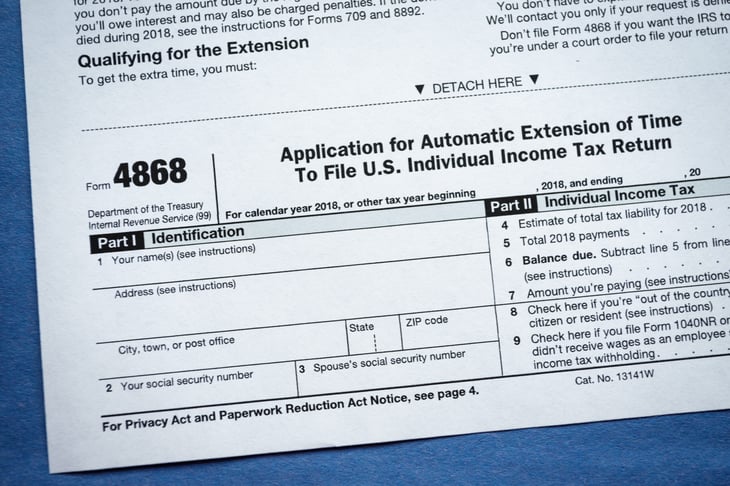
One of the costliest tax mistakes is skipping a filing extension when you can’t pay. Many assume there’s no point in filing without full payment — but that triggers steep penalties.
The late-filing penalty is 5% per month (up to 25%) of unpaid taxes.
The late-payment penalty is just 0.5% per month, also capped at 25%.
If you owe $10,000:
- Filing late could cost you $500/month, up to $2,500
- Paying late adds only $50/month, up to $2,500
File Form 4868 on time — even without a payment — to avoid the harsher penalty.
Pro Tip: Struggling with tax debt? Alleviate Tax works directly with the IRS on your behalf which could help you get out of tax debt faster. Their team explores options that may even reduce what you owe. If you have $10,000+ past due, answer a few questions to see if you qualify today!
2. Misunderstanding extension deadlines in disaster areas

The IRS offers special tax relief that automatically extends certain deadlines for victims of Hurricane Helene and the Los Angeles wildfires. Still, many affected taxpayers miss out due to confusion over how the provisions work.
If you’re in a federally declared disaster area, you may qualify for an automatic extension without filing Form 4868 — but that doesn’t mean the process should be ignored.
Tax experts recommend checking the IRS disaster relief page and consulting a professional, as requirements can vary depending on the type of disaster and your location.
Pro Tip: If you have more than $20,000 in unsecured debt, get some professional help. National Debt Relief is a trusted source for free advice and assistance.
3. Assuming an extension gives you more time to pay

One of the most common tax extension myths is that it gives you more time to pay. In reality, extensions only grant more time to file, not to pay what you owe.
Taxes are still due by the original deadline, even if you file an extension. When submitting the extension request, you must estimate and pay your tax liability to avoid late-payment penalties and interest, which are currently around 8% annually.
Advisors suggest paying at least 90% of your expected taxes to avoid penalties, especially given potential market volatility in 2025 impacting income estimates.
Pro Tip: Boost your shopping power and pay less interest: Get 0% intro APR for purchases and balance transfers for 15 months. Plus, earn a bonus of 20,000 miles once you spend $500 on purchases within 3 months from account opening.
4. Overlooking Q1 estimated taxes due simultaneously

A particularly costly blunder occurs when taxpayers focus so intently on their extension for the previous year that they forget entirely about first quarter estimated taxes for the current year — both due on the same date, April 15.
Self-employed? If you had a profitable first quarter in 2025, don’t forget to pay your first quarter tax.
Failing to make this payment can trigger underpayment penalties, and the IRS has increased interest rates on underpayments in recent years, making this oversight even more expensive.
Pro Tip: Put as much money as possible into a retirement savings or investment account to reduce your tax liability. Start today with matched contributions! Sign up for a SoFi IRA and take advantage of compounding interest. Get started today.
5. Missing the Section 475 MTM election deadline

A critical deadline for eligible traders with trader tax status coincides with the tax extension filing: the deadline to elect Section 475 mark-to-market accounting.
This election must be filed by the tax filing deadline for individuals and C-corporations, usually 30 days earlier for partnerships and S-corporations.
Many traders don’t realize that this election statement must be attached to your timely filed tax return or your extension request. Missing this deadline means losing the opportunity until the following tax year.
Pro Tip: Need expert advice on tax savings investment strategies? Talk to a professional financial advisor if you have over $150,000 in investments. WiserAdvisor is a free service that will match you with a pro in your area.
6. Rushing to file after submitting the extension

Many taxpayers stress over filing quickly after requesting an extension, even when waiting for corrected 1099-Bs or K-1s is the smarter move.
Seasoned filers know the real deadlines are often in September for pass-throughs and October for individuals. Rushing can lead to amendments and unwanted IRS attention.
Many accounting firms now prefer clients file extensions to allow for more accurate, complete returns.
Pro Tip: Over 50 and concerned about today’s market volatility? Explore diversification with the potential to receive up to $10,000 in free metals through qualified purchases. Protect your retirement with precious metals: FREE 2025 Gold Information Kit. If you’re curious about investing in gold, now’s a good time to learn more.
7. Being too aggressive and focused on a tax refund

While it might be tempting to file an extension to claim as many deductions as possible, large refunds year after year will draw scrutiny.
The IRS uses sophisticated software to identify taxpayers who consistently generate large refunds as potentially being overly aggressive with deductions or credits.
For maximum deductions, tax professionals and financial advisors can help you identify the best route to avoid owing the IRS and claiming the most deductions.
Pro Tip: Talk to a financial advisor and get advice from an expert. If you’ve got more than $100,000 in savings, get help today. SmartAsset offers a free service that matches you to a vetted fiduciary advisor in less than 5 minutes.
8. Overlooking retirement plan funding deadlines

Many taxpayers don’t realize that filing an extension also extends the deadline for funding certain qualified retirement plans, offering flexibility for cash flow and tax planning.
The funding deadline is extended to October for plans like SEP IRAs, Solo 401(k)s, and defined benefit plans. However, traditional and Roth IRAs still have an April deadline.
The extended time is especially valuable for self-employed individuals and small business owners, including traders, who need more time to calculate contributions based on fluctuating income.
Pro Tip: Use your extended time to your advantage by earning as much as possible on your emergency savings. For example, SoFi Checking offers 3.8% interest, plus a potential $300 signup bonus. (Rates and offers may change without notice.)
9. Neglecting state tax extension requirements

While federal extensions get much attention, many taxpayers overlook state-specific requirements. Some states automatically grant extensions with a federal filing, while others require separate forms and payments.
The complexity has grown with the rise of state pass-through entity (PTE) tax elections, which now exist in over 30 states as workarounds to the federal SALT deduction cap. These elections may have differing deadlines and extension rules.
Tax professionals warn that states are less lenient than the IRS with penalties, so it’s important to follow state-specific guidelines.
Pro Tip: Need to file an extension but can’t wait for your refund? Consider a home equity loan; it’s a great way to access fast cash with tax benefits. Take a minute right now and see how much you can get, how fast you can get it and how little you'll pay.
Navigating extensions with confidence

Understanding tax extensions isn’t just about avoiding penalties—it’s about strategically managing your tax situation to maximize benefits and minimize stress.
Remember that extensions are not procrastination—they’re a legitimate tax planning tool used by financial professionals and sophisticated taxpayers to ensure accuracy and maximize tax benefits.
Pro Tip: Need to use up those HSA Funds? Hearing aids may qualify for hearing aids, and the FDA has a new rule allowing people with hearing loss to buy top hearing aids without a prescription.

Add a Comment