



Many people find white noise soothing when they try to drift off to sleep. But there can be some hidden dangers to getting your slumber in an atmosphere of background sound.
The term “white noise” refers to a consistent sound that includes all frequencies across the sound spectrum that are audible to humans.
White noise might be most celebrated for helping folks fall asleep and stay that way. Many people use a white noise machine or a simple fan to generate a constant sound in the background as they sleep.
Researchers can’t say for sure whether there is a quality inherent in white noise that promotes relaxation or if it simply works its magic by masking background noise. Whatever the reason, many people rely on white noise to get quality shut-eye.
But there are some overlooked dangers to sleeping in an atmosphere of white noise. Here are ways white noise can damage your hearing — even permanently.
Hearing loss

You might think your hearing is only at risk if you are exposed to a single, very loud sound. And it’s true that exposure to a sound that is 120 decibels or more can damage your hearing.
But slightly quieter sounds can also damage your hearing over time. For example, the Centers for Disease Control and Prevention says listening to sounds of around 85 decibels or higher over an extended period in the workplace also can damage your hearing.
The maximum volume of white noise machines is unregulated and can exceed 91 decibels, according to a 2024 study published in Sleep Medicine, the scientific journal of the World Sleep Society and International Pediatric Sleep Association.
That means daily or nightly exposure to a white noise machine running at its peak output could put your hearing in jeopardy.
The good news is that noise-induced hearing loss is considered entirely preventable if you avoid such loud sounds, according to the CDC. But the bad news is that damage to your hearing can occur gradually. By the time you notice the damage, it might be too late, as hearing loss is often permanent.
Here are real-life examples of how loud the above sound levels are:
- 80 decibels: Police siren or a noisy restaurant
- 90 decibels: Hair dryers, blenders, power tools
- 120 decibels: Thunder, concerts, jet planes

Tinnitus
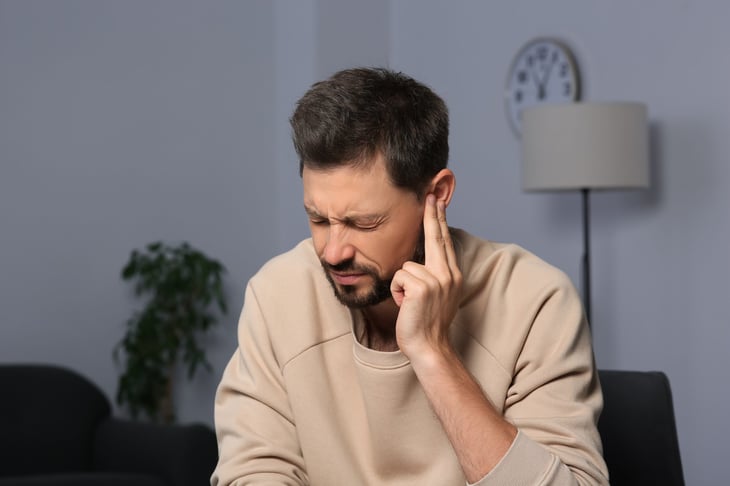
Tinnitus is a perception of sound that does not involve an external source. This condition impacts people in various ways, but those who have tinnitus often describe hearing ringing, buzzing, hissing or clicking.
Prolonged loud sounds are among the known causes of tinnitus, according to the American Tinnitus Association. So, over time, listening to white noise that’s too loud could cause tinnitus.
For people who already have tinnitus, listening to white noise might make the condition worse.
Tinnitus can be maddening and distracting, so some people who have this condition try to drown it out via white noise.
But white noise might actually “rewire” the brain in ways that negatively affect how the brain processes sounds. That might in turn worsen tinnitus, according to a 2018 review of scientific studies published by the American Medical Association.

Hampered auditory development

A 2003 study of young rats exposed to continuous white noise found that the noise wreaked havoc on the development of the auditory region of the animals’ brains.
The researchers at the University of California, San Francisco, who conducted the study concluded that such damage can impair hearing and language acquisition.
The conditions used in the study were intended to mimic type of random noise humans routinely experience today. The researchers speculate that the study findings might hint at a potential cause for the increase in language-impairment developmental disorders among humans over the last several decades.
According to a summary of the researchers’ findings, which were published in Science, a journal of the American Association for the Advancement of Science:
“While the rat is not a perfect model of human auditory development, it does allow us to investigate the fundamental role of early sensory experience in mammalian auditory development.”


Add a Comment