


Editor's Note: This story originally appeared on LawnStarter.
Struggling to choose the right types of ornamental grass for your landscape? You’re not alone. Whether you need blue oat grass for low-maintenance color or Japanese forest grass to brighten shady garden corners, your solution is here.
We break down cool-season, warm-season, and evergreen grasses by growing conditions, size and seasonal interest, helping you select the perfect ornamental grasses that will thrive in your specific climate and space.
Cool-Season Ornamental Grasses
Cool-season ornamental grasses are the first to emerge in the spring and the last to dry out in the fall. They thrive in the cooler climate of northern U.S. and are, usually, small to mid-sized with plumes developing in late spring to early summer.
Elijah Blue Fescue (Festuca ovina glauca)

‘Elijah Blue’ is the most popular cultivar of blue fescue. It forms neat, dome-shaped tufts of silvery, light-blue foliage that intensifies to striking blue-gray during summer heat. This low-growing ornamental grass stays under 1 foot tall, making it ideal for groundcover, borders, or filling small spaces throughout the yard.
Pro Tip: Space plants 8 to 10 inches apart for best coverage, as this grass maintains tight clumps rather than spreading outward. Or, find a landscape professional to design and install your landscape.
- USDA zones: 4-8
- Growing conditions: Full sun. Moist, well-drained soil.
- Size: 1 foot tall and wide
- Seasonal interest: Year-round (foliage)
Mix with: Yucca, daylily, bluebeard
Mexican Feather Grass (Nassella tenuissima)

Mexican feather grass forms silky-green clumps topped by delicate, light green plumes. Its superfine hair-like leaves add softness to Mediterranean gardens with architectural plants like agave and yuccas and smooths the transition between lawns and wilder areas.
Don’t let the cool-season label fool you. Mexican feather grass can withstand high temperatures and is one of the best ornamental grasses for full sun and dry conditions. It’s also less cold-hardy — a perennial in zones 7-10, but an annual in zones 2-6 where it dies when temperatures fall below 20 F.
- USDA zones: 7-10
- Growing conditions: Full sun. Fertile, well-drained soil.
- Size: Up to 2 feet tall and 3 feet wide
- Seasonal interest: Spring to late fall
Mix with: California poppy, columbines, and coneflowers
Note: It’s a heavy seeder and considered an emerging invasive in California.
Northern Sea Oats (Chasmanthium latifolium)
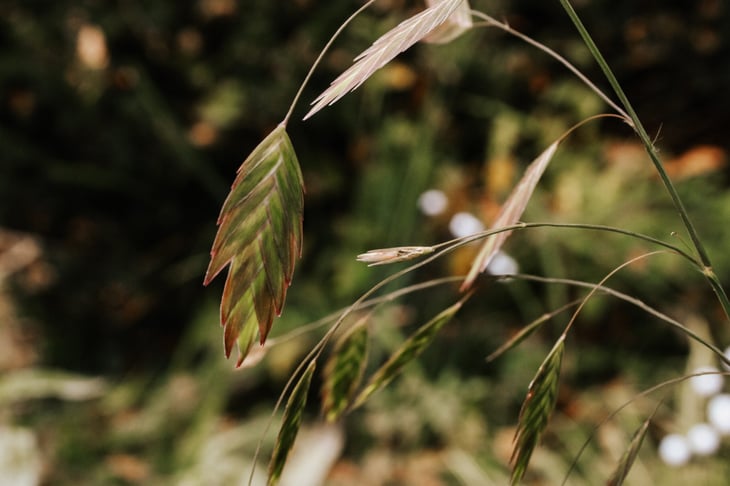
One of the best ornamental grasses for shade, this Texas native becomes a true set-it-and-forget-it plant when grown in shady areas with moist soil. What makes it special are those large oat-like flowers that go from green to golden and warm-ivory during the season.
Place it under dense oak trees, at the base of rainwater harvesting berms, or along streams for erosion control.
- USDA zones: 3-8
- Growing conditions: Dappled sunlight to partial shade. Moist to wet, well-drained soil.
- Size: 2-5 feet tall, 1-2 feet wide
- Seasonal interest: Spring to fall
Mix with: American beautyberry, Texas mountain laurel, Turk’s cap
Note: It’s a self-seeder that can turn invasive.
Tufted Hair Grass (Deschampsia cespitosa)
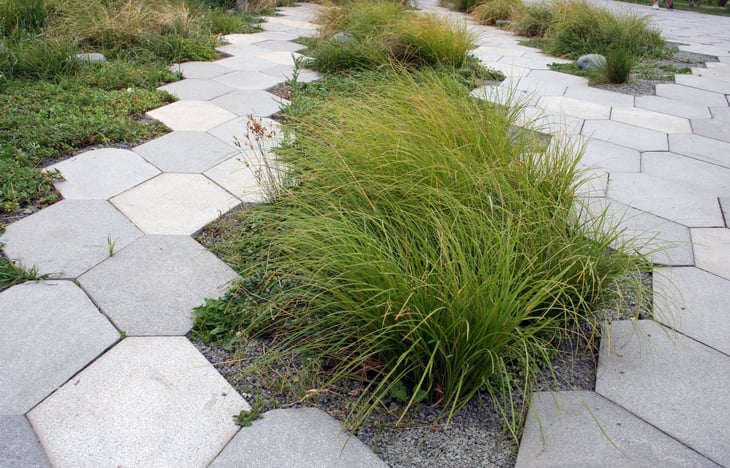
Tufted hair grass grows in deep-green clumps with purplish or bronze plumes. In fall, the foliage develops subtle golden highlights, while the dried panicles provide some of the most striking winter interest among landscape grasses.
Plant in drifts where the lawn meets deep tree shade; use it in rain gardens. To maintain this beauty, check our guide on when to cut back ornamental grasses.
- USDA zones: 4-9
- Growing conditions: Part shade. Well-drained soil.
- Size: 2-3 feet tall, 1-2 feet wide
- Seasonal interest: Early summer to late fall
Mix with: Cardinal flower, plantain lilies, or ferns
Warm-Season Ornamental Grasses
Warm-season ornamental grasses love the heat and grow best in the South. They emerge more slowly in the spring and bloom later in the season, but they reward patience with more dramatic colors and textures. In this category you’ll find the best tall ornamental grasses for privacy screens.

Japanese Forest Grass (Hakonechloa macra)
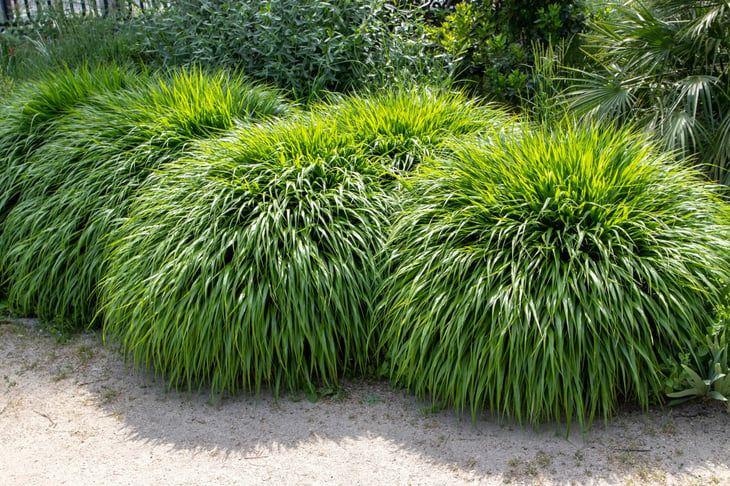
Unlike most warm-season grasses, Japanese forest grass prefers the shade and displays its most vibrant colors when shielded from direct sun. It has wide, cascading blades that turn a bright yellow-gold hue in the shade and a more faded lime hue in the sun.
Plant it in those shady garden corners you want to illuminate. Then all you have to do is relax and enjoy the view — it’s a slow-growing ornamental grass that doesn’t require much maintenance.
- USDA zones: 5-10
- Growing conditions: Part to full shade. Moist, well-drained soil.
- Size: Up to 1.5 feet tall and wide
- Seasonal interest: Spring to fall
Mix with: Hostas, astilbe, heuchera
Little Bluestem (Schizachyrium scoparium)
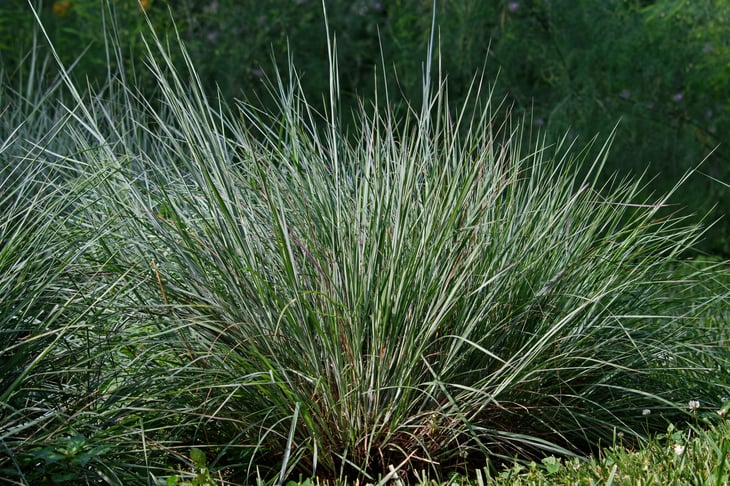
Little bluestem is a resilient blue-green grass that turns reddish to yellowish-orange in the fall and provides winter interest through its tan inflorescences.
Heather Evans, a master gardener and the writer of DesignYourWild.com, the No. 1 North American garden design newsletter on Substack, says this prairie native is excellent as a background grass in “meadow-like mixes of grasses and wildflowers.” Pair it with other plants with showy seedheads, like spotted bee balm, and you’ve got a gorgeous winter yard.
- USDA zones: 3-9
- Growing conditions: Full sun and well-drained soil
- Size: Up to 4 feet tall
- Seasonal interest: Summer to winter
Mix with: Spotted bee balm, rattlesnake master
Pink Muhly Grass (Muhlenbergia capillaris)
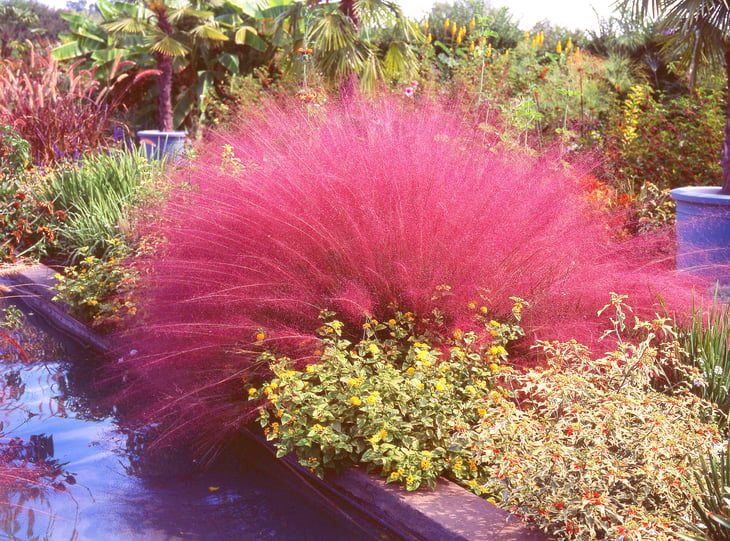
Pink muhly grass is an upright-growing grass that fills with clouds of pink flower plumes every fall and is Evans’s “absolute favorite ornamental grass.” The high salt tolerance and ability to grow “in pure sand” makes it an ideal choice for oceanfront properties.
“I grow it in groups of 5 and 7 on either side of my Florida driveway, which is occasionally inundated with salt water,” says Evans. She recommends mass-planting “in groups or as a 3-foot border” for the best visual impact.
- USDA zones: 6-9
- Growing conditions: Full sun. Well-drained soil.
- Size: 3-4 feet tall and 2-3 feet wide
- Seasonal interest: Fall
Mix with: Dune sunflowers, blanket flowers, and goldenrod
Purple Fountain Grass (Pennisetum setaceum ‘Rubrum’)

Purple fountain grass is a perennial ornamental with deep burgundy foliage, pink-to-purple seedheads, and a gracefully cascading form. As one of the most drought-tolerant ornamental grasses available, it thrives in xeriscapes and rock gardens with minimal water requirements.
- USDA zones: 9-11
- Growing conditions: Full sun. Well-drained soil.
- Size: 3-5 feet tall, 2-4 feet wide
- Seasonal interest: Spring to late fall
Mix with: Russian sage, alliums, coleus
Note: Fountain grasses are considered invasive in Virginia, Maryland, and the District of Columbia. Alternatives: ‘Karley Rose’ fountain grass (less invasive), pink muhly grass.
Switchgrass (Panicum virgatum)
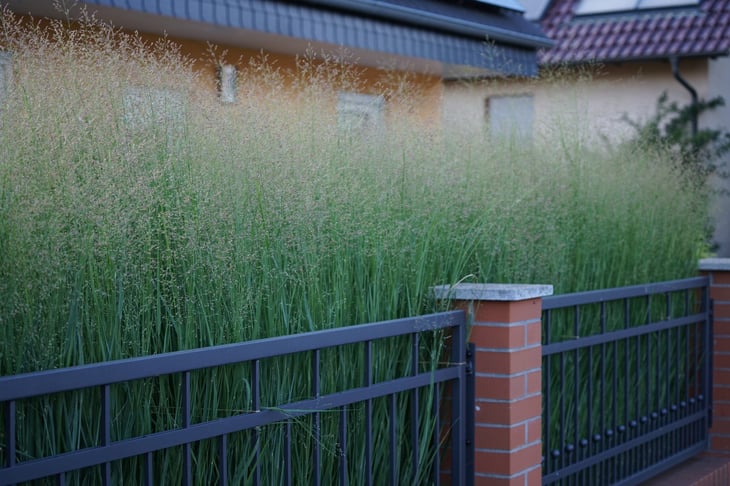
Switchgrass is a tall decorative grass that forms dense, upright clumps. During summer, airy plumes emerge and the foliage transforms from green to striking blue (‘Dallas Blue’) or rich purple (‘Shenandoah’), depending on the cultivar.
Butterflies and moths rely on switchgrass for shelter and food, making it invaluable for native landscapes, meadows, and pollinator gardens.
- USDA zones: 5-9
- Growing conditions: Full sun to part shade. Prefers moist, well-drained soil.
- Size: 4-6 feet tall, 2-3 feet wide
- Seasonal interest: Summer and fall
Mix with: Black-eyed Susan, stonecrop, tall verbena
Evergreen Ornamental Grasses
Evergreen ornamental grasses maintain their color year-round and skip the annual cutback requirement. Though, if maintenance is needed, our guide on how to cut back ornamental grasses covers the proper techniques.
Black Mondo Grass (Ophiopogon planiscapus)

Black mondo grass creates visual impact with its dense, dark violet-to-black foliage and delicate pinkish-white to dark purple flowers. It’s a dramatic ornamental grass that works beautifully as border, groundcover, and edging along streams and ponds.
For the most intense coloration, plant this low-growing ornamental grass in full sun where the foliage develops its exquisite deep, dark hues.
- USDA zones: 4-8
- Growing conditions: Part sun to part shade. Moist, fertile, slightly acidic, well-drained soil.
- Size: 8-12 inches tall and wide
- Seasonal interest: Year-round
Mix with: Silver mound, lamb’s ear, coral bells
Blue Oat Grass (Helictotrichon sempervirens)
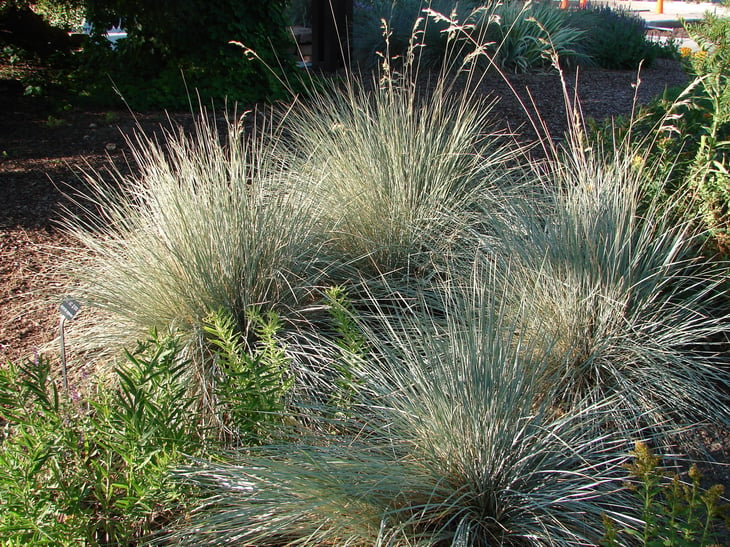
Blue oat grass forms bristly, tidy mounds with an elegant steel-blue color that creates powerful contrasts — whether paired with warm green foliage, bright cottage garden blooms, or the muted tones of rock garden settings. As many other small ornamental grasses, it needs little care and is a great choice for low-maintenance landscapes.
- USDA zones: 3-8
- Growing conditions: Full sun to part shade. Dry, well-drained soil.
- Size: 1-3 feet tall and wide
- Seasonal interest: Year-round
Mix with: Japanese anemone, turtlehead, ‘Blue Star’ juniper
Japanese Sedge ‘Evergold’ (Carex oshimensis ‘Evergold’)
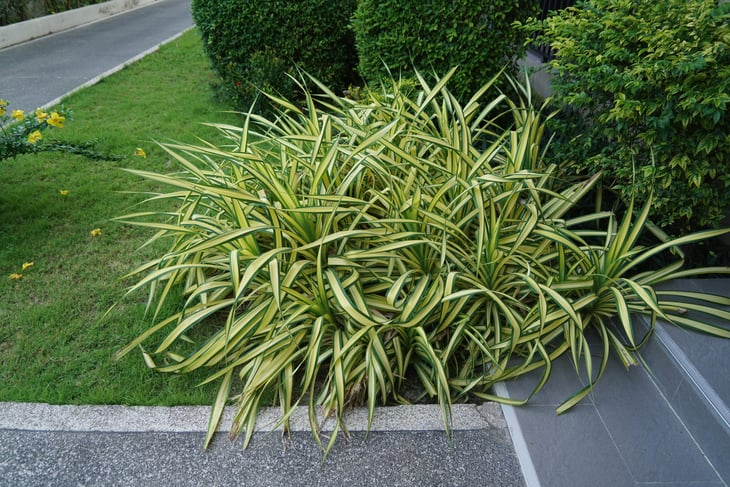
The Japanese sedge ‘Evergold’ impresses through its variegated foliage — each blade showcases a creamy-yellow center stripe bordered by dark green edges. This creates a bright, cascading effect that maintains vibrant color even when many other perennial ornamental grasses fade in the winter.
Shade-tolerant by nature, this dwarf ornamental grass thrives on the north sides of buildings and under dense tree canopies.
- USDA zones: 5-10
- Growing conditions: Part shade. Dry to moist, rich, well-drained soil.
- Size: 8-18 inches tall, 12-16 inches wide
- Seasonal interest: Bright variegated blades year-round
Mix with: Wild blue phlox, wild columbine, Heuchera americana ‘Dale Strain’
‘Pumila’ Pampas Grass (Cortaderia selloana)
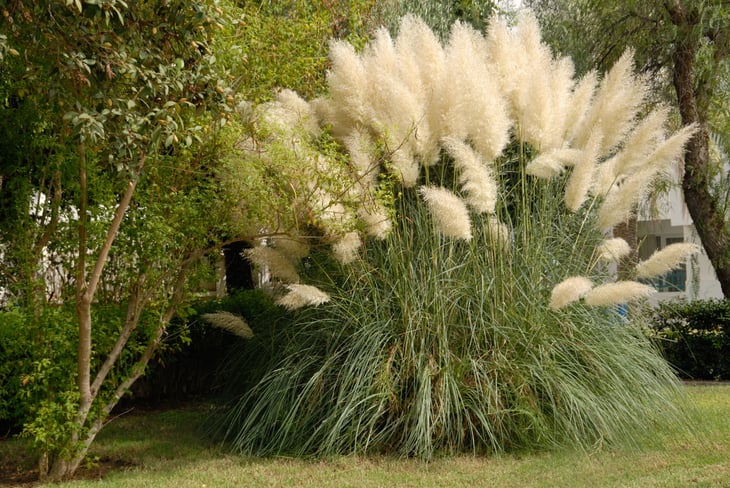
When landscaping with pampas grass in a small or mid-sized yard, consider the ‘Pumila’ cultivar. It’s a shorter variety, reaching up to 6 feet tall, with spectacular white, feather-like plumes that illuminate the garden. Plant it near sitting areas or as a dramatic backdrop behind garden beds.
- USDA zones: 7-11
- Growing conditions: Full sun or light shade. Dry to moist, well-drained soil.
- Size: 4-6 feet tall and 3-5 feet wide
- Seasonal interest: Showy flower plumes late summer through winter.
Mix with: Juniper, boxwood, Verbena bonariensis
Note: Pampas grasses are considered invasive in several western states. Monitor for spreading runners or consider feather reed grass (Calamagrostis ‘Karl Foerster’) instead.

Add a Comment