



Editor's Note: This story originally appeared on Live and Invest Overseas.
The key to living long-term overseas — and to escaping home at a moment’s notice if you need to — is residency and/or citizenship overseas.
You can obtain residency or citizenship in more than one country. However, most expats obtain residency or a second citizenship in just one country outside their home country. Which country depends on your personal goals.
Reasons for seeking residency or citizenship
Maybe you simply want to know you have a place to retreat to if things get too bad in your home country.
Or perhaps you want to be able to spend more time each year in a country than that country’s tourist visa allows.
Or maybe you’re looking to move to another country full-time.
While most countries offer viable options for taking up full-time residency, some countries make more sense than others as backup residency options (i.e., for your emergency “get out of Dodge” plan).

The power of a second citizenship

Acquiring a second citizenship is typically a later step in any go-offshore plan. Most people don’t start here.
And not everyone is interested in the idea of obtaining a second passport at any stage.
Understand, though, that this can be the single most powerful option for creating options … not only for you but also for your children (because you can pass on your citizenship rights).
The world is an ever-changing place. A U.S. passport is still one of the best in the world today, but what value will that passport have in 10 or 20 years … or a generation after that? Impossible to say.
In the late 1800s, the United Kingdom was recognized as the major world power, and many probably expected that to continue indefinitely. But Britain’s global reign ended after World War II and the breakup of its empire.
Today, that country is still economically, politically, and militarily strong, but it’s not a superpower.

It’s about the future

The United States could still be the major power in the world in another 100 years … but it probably won’t be.
Will it still be someplace your great-grandchildren will be able to find economic and personal security? I hope so.
But why not give them options and hedge their bets by obtaining a second citizenship that can be passed down to them?
A second citizenship also gives you immediate residency and the right to work in a country.
Maybe those things are important to you now … maybe they’re not. But maybe they could be important to your future generations.

A personal example: Irish citizenship
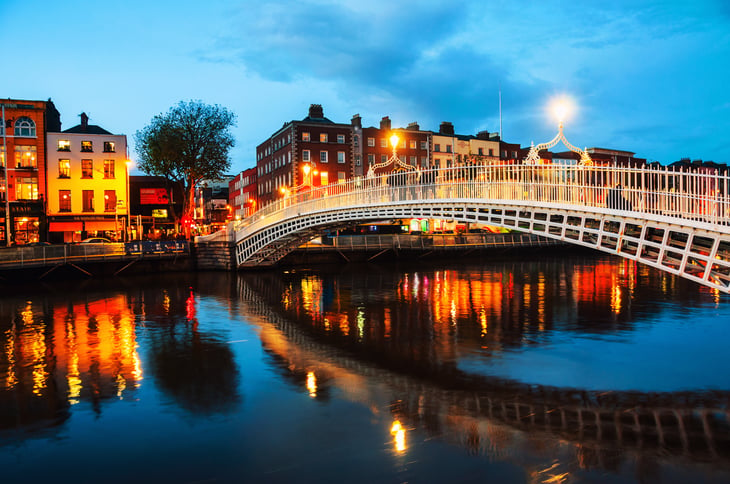
Kathleen and I both hold Irish citizenship and Irish passports, thanks to the time we spent in Ireland. We became naturalized Irish citizens.
When I first suggested to Kathleen that we get naturalized in Ireland once we were eligible, she wasn’t terribly interested in the idea. It required paperwork, and she dislikes administrative tasks.
Her attitude changed when having Irish citizenship allowed us to live in Paris full-time when we decided to move there (because both countries are part of the EU).
When the coronavirus pandemic closed off travel routes, she was even happier that we had options and were able to make travel plans thanks to this decision made more than a decade before.

The benefits of internationalization

My immediate family all came together for Christmas during the pandemic in Chamonix, France. We followed the lockdown rules in France, but the fact that we were all able to be in France during the pandemic is a testament to the 30 years of internationalization I’d done, including — and most importantly — getting second citizenship.
Our granddaughter was able to take in her first sledding experience in the shadow of Mont Blanc because her parents moved to France before she was born. Our daughter wanted to live in the culture and art that overflow in Paris.
Our son, thanks to the pandemic, skipped his classes at NYU Shanghai since he wasn’t interested in taking remote classes. He used that time to work on various music projects, including his first album. Then he was able to take in-person classes from NYU in Paris the next semester, thanks to his Irish passport.
Kathleen and I were able to go to the States to help my mother with some work on her house over the summer and return to Paris via Ireland … again, thanks to our Irish passports.
We had residencies, citizenships, properties, and bank accounts organized to allow us this very flexible international life … even in the most inflexible times.


Add a Comment